
Lighting guide · India · 28 October 2026
Branded vs local lighting: what should you really buy?
Two LED downlights can look almost identical. One costs ₹400, another ₹900, and somewhere nearby there is probably one for ₹200. All three switch on—so what exactly are you paying for?
Welcome to India’s lighting industry—one of the most competitive, innovative and occasionally confusing categories in building a home.
LED technology has made lighting efficient, attractive and affordable. It has also made entering the category relatively easy. The market now stretches from established manufacturers such as Philips/Signify, Havells, Crompton and Jaquar to specialised regional brands, private labels and thousands of smaller assemblers and traders.
That competition is not inherently bad. It has brought better designs, lower prices and far greater choice. The difficulty is that two fixtures that look identical from the outside may perform very differently inside.
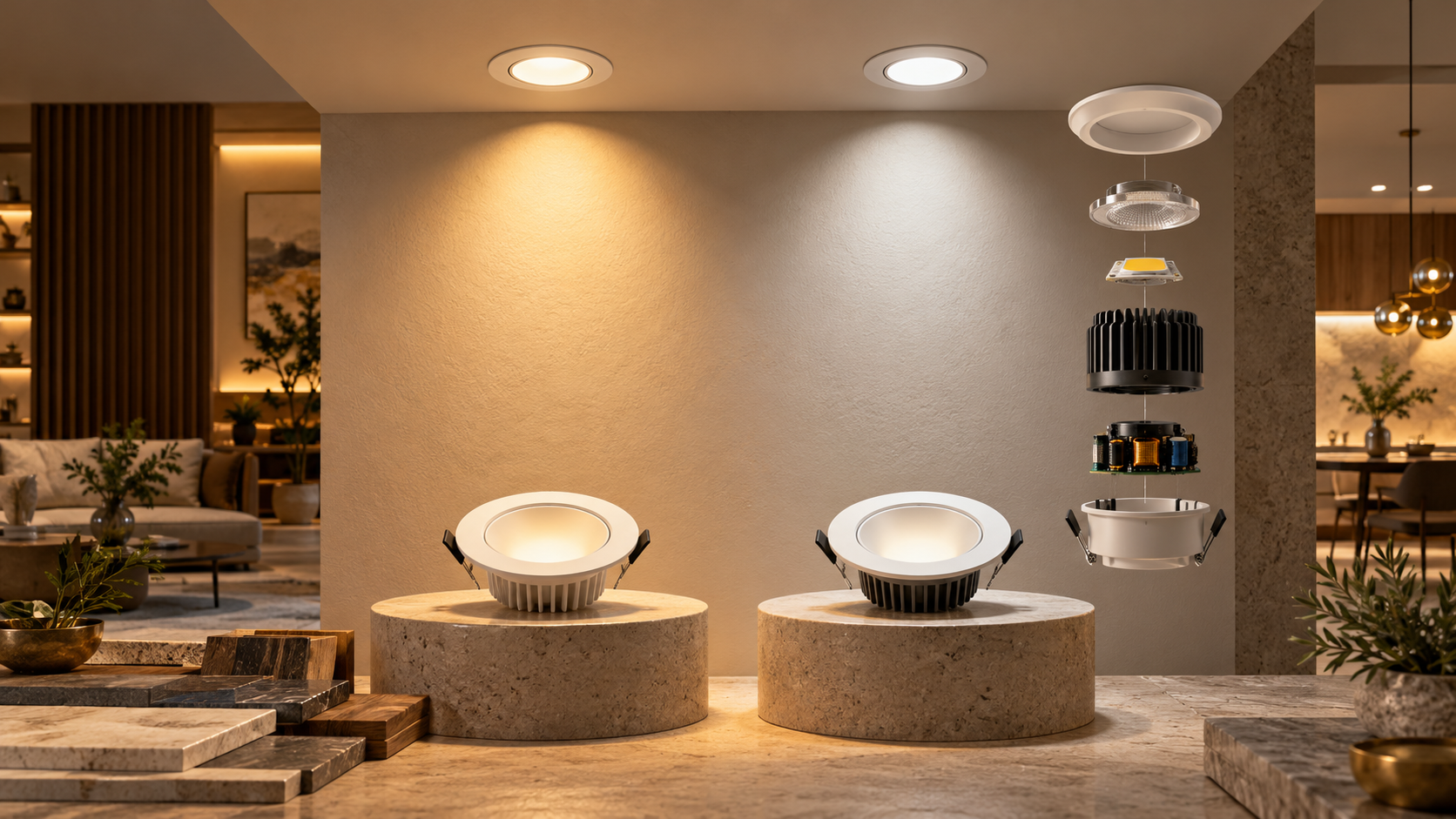
Most of what you are paying for is hidden.
Inside a luminaire are LED chips, a driver, PCB, heat-management system, optics, wiring and connectors. Two 12W downlights can share a wattage and appearance yet differ substantially in light quality and useful life.
The better question is not “How bright is it today?” but “How will it perform after thousands of hours?”
Why are local or lesser-known lights cheaper?
Not every lower-priced light is poor quality. Some regional manufacturers produce good products while spending less on advertising and distribution. Others compete primarily on price.
Cost can be reduced through simpler drivers, lighter heat sinks, basic optics, lower component specifications, limited testing, shorter warranties or a smaller service network. Sometimes the inexpensive product performs perfectly well. The uncertainty is often consistency: will the next batch match, will the colour remain uniform, and will compatible replacements exist two years later?
Brand vs non-brand: the practical comparison
Established brand
Advantages
- More consistent product specifications
- Better quality-control systems
- Clearly stated technical data
- Established warranty process
- Larger dealer and service network
- Better chance of compatible replacements
- Greater confidence for large projects
Trade-offs
- Higher purchase price
- Part of the premium supports distribution, marketing and service infrastructure
- A brand name does not automatically make every product the best value
Local or lesser-known brand
Advantages
- A significantly lower initial cost may be possible
- Huge variety of designs
- Quick response to decorative trends
- Some regional manufacturers offer excellent value
- Useful where replacement is simple and inexpensive
Trade-offs
- Quality can vary substantially
- Technical information may be limited
- Batch-to-batch consistency can be uncertain
- Support depends heavily on the seller and manufacturer
- Matching the same model later can be difficult
Should you always buy branded?
No. That would be too simplistic.
Ask instead: what happens if this light fails?
A ₹250 decorative bulb in an accessible table lamp takes two minutes to replace. Taking a calculated chance on an inexpensive product may be perfectly sensible.
Now imagine 60 recessed lights in a false ceiling, 200 lights in a showroom, or façade lights mounted several metres above ground. A failure can also mean electrician charges, ladders or scaffolding, ceiling damage, labour, colour mismatch and inconvenience. Saving ₹100 per fixture suddenly feels less exciting.
The hidden cost of cheap lighting
Thirty 12W downlights: ₹300 versus ₹600
Initial saving with the cheaper option
Fixtures that need to remain consistent
That should cost less trouble over its useful life
If several fixtures fail and the model disappears, replacements may have a different colour temperature, brightness, cut-out size or visible trim. The real question is not which light is cheaper—it is which lighting system will cost less trouble.
Do not buy watts. Buy light.
Wattage tells you roughly how much electrical power a product consumes. It does not tell you everything about the quality or usefulness of the light produced.
Lumens
How much usable light does the product actually produce?
CRI
How naturally will colours, finishes, food and skin tones appear?
Colour temperature
Is it 3000K warm white, 4000K neutral or 6500K cool white—and will every fixture match?
Driver quality
The hidden component that strongly influences flicker, stability and reliability.
Heat management
LEDs dislike excessive heat. A well-designed heat path protects performance.
Beam angle and optics
The same lumen output can feel completely different when light is controlled well.
IP rating
Essential context for bathrooms, façades, gardens and other exposed locations.
Warranty support
Not only the warranty period, but who will actually honour it and how.
Our recommendation: do not choose by brand alone
There are excellent established brands, good smaller manufacturers and poor products at almost every price level. Make the decision technical rather than emotional.
Spend more carefully where failure matters.
False ceilings, kitchens, bathrooms, façades, high ceilings, outdoor areas, commercial spaces and large installations deserve stronger weight on reliability, consistency and support.
Experiment where replacement is easy.
Value-oriented products can make sense for accessible decorative lamps or temporary applications.
Mix products intelligently.
An entire home does not need one logo. Match the engineering, price and support level to each application.
The bottom line
“Looks the same” does not mean “is the same.”
Do not simply buy the cheapest light, but do not buy a logo blindly either. Look at the specifications, warranty, application and the people supporting the product after the sale.
The best lighting purchase is the one you do not have to think about again after installation.
Lighting advice at The Build Mart
Start with the space—not a catalogue.
At The Build Mart, Bikaner, our team can help you compare brightness, colour temperature, beam angle, application, aesthetics and long-term service requirements for a home, showroom, office, façade or outdoor area.
Build Better Together.
Technical note
Specifications and warranty terms vary by manufacturer and product series. Confirm photometric data, installation conditions, electrical compatibility, IP rating and service terms for the exact product before purchase.
Bureau of Indian Standards